
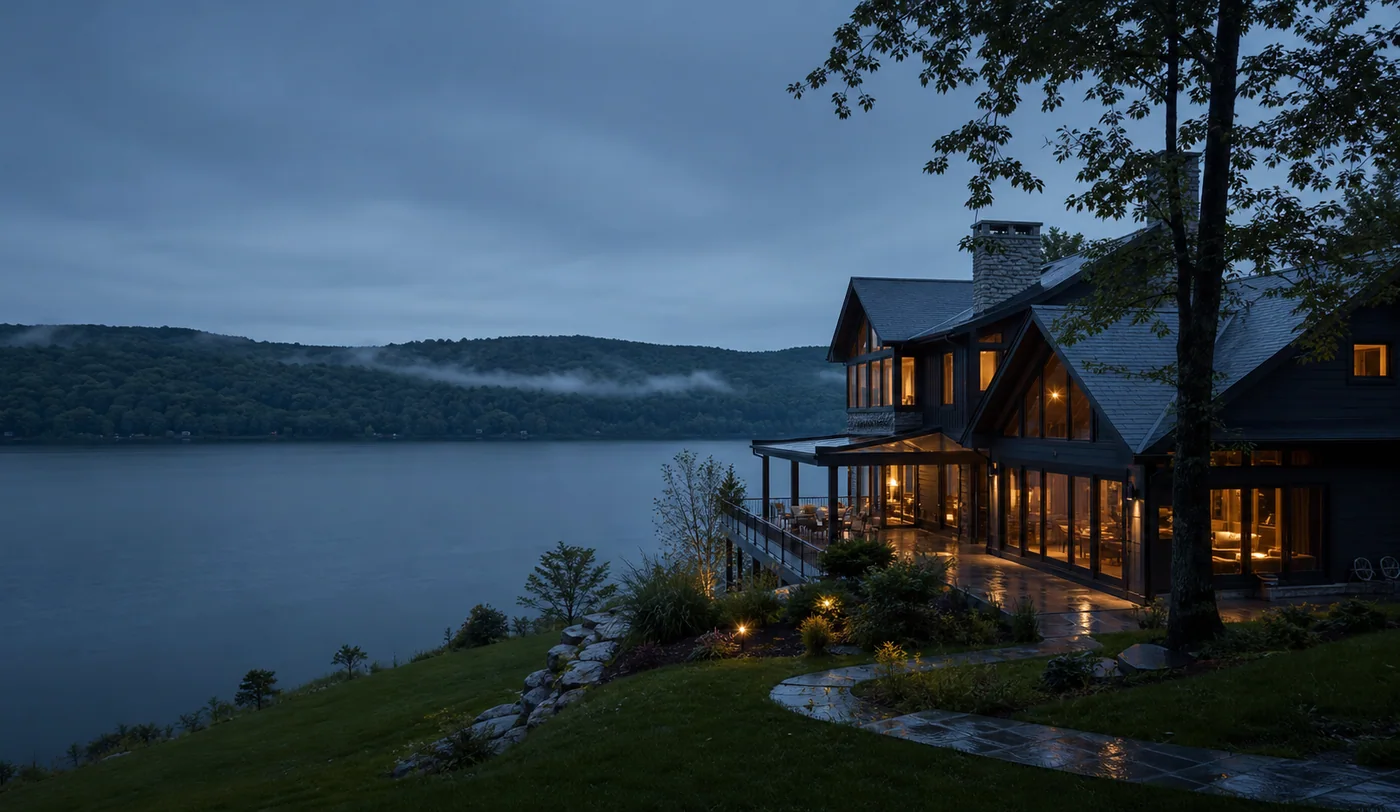
Finger Lakes property ownership often comes with distance. A lake house may be occupied every weekend in summer, occasionally during the shoulder season, and only briefly through winter. The property still has pipes, heat, smoke alarms, doors, outbuildings, shoreline weather, and utility costs when nobody is there.
This guide was prompted in part by a conversation with a law-enforcement officer in the Finger Lakes area about the practical vulnerability of seasonal properties. That conversation is context, not a statistical study. We found no authoritative dataset proving a region-wide “off-season burglary spike,” so this article does not claim one.
Instead, it uses published New York crime-data sources and local property-check guidance to build an honest protection plan for owners around Canandaigua, Keuka, Seneca, Cayuga, Skaneateles, and the surrounding lake communities.
What Finger Lakes burglary statistics can—and cannot—tell you
New York’s Division of Criminal Justice Services publishes reported index-crime data by county and police agency. Burglary is one of the property-crime categories. These annual totals are useful context, but they do not automatically identify:
- A vacation or seasonal home.
- Whether a property was occupied.
- The season or reason the incident occurred.
- A lakefront, village, city, or rural setting.
- The exact risk for an individual address.
Use county data to understand the broader picture, then ask the local sheriff or police department about the property and current conditions. Avoid converting an annual county total into an unsupported claim that break-ins surge every winter.
A more practical local signal is that Ontario County offers a formal property-check request, sometimes called a dark-house watch. Its form lists reasons such as vacation, a suspicious person or vehicle, criminal mischief in the area, or a vacant house. Availability and eligibility differ by jurisdiction, but the service illustrates a sensible principle: tell the right local authority when a property will be empty and ask what programs exist.
Remote sensing can complement a local check. It does not replace patrols, emergency reporting, physical security, or a trusted person who can inspect damage.
Start Finger Lakes vacation home security at the driveway
Seasonal properties can signal vacancy through uncollected packages, untouched snow, unmaintained landscaping, dark exteriors, and vehicles that never move. Arrange visible maintenance and keep the property looking cared for.
Walk the perimeter:
- Repair doors, windows, screens, latches, and frames.
- Lock garages, sheds, boathouses, and utility structures.
- Secure ladders, tools, fuel, and equipment.
- Trim foliage that blocks views of entry points.
- Maintain exterior lighting without shining into neighboring properties.
- Remove hidden spare keys and control access codes.
Then add door, window, and motion sensing for confirmed vacancy periods. A sensor does not make a weak frame strong; it shortens the time before the owner knows something changed.
Build a lake-house water plan
Water risk extends beyond a sink. A lake property may have a well, pump, pressure tank, treatment equipment, irrigation, boiler, seasonal plumbing, dock utility, sump, or low basement.
Ask a local plumber which systems should remain active and whether winterization, heat, draining, fixture isolation, or a main shutoff is appropriate. The answer changes by building and occupancy plan.
For a property that retains a pressurized supply, use point leak sensors at likely sources and consider a compatible automatic valve. The EPA WaterSense guide notes that automatic or remote shutoff can be especially helpful in a vacation home without regular occupancy.
Make sure the valve can report that it actually closed. A request to close is not the same as a confirmed shutoff. If the valve does not respond, alert the owner and local helper immediately.
Watch freeze risk where the pipe actually runs
The thermostat reading may not represent a crawlspace, exterior wall, utility room, or detached pump house. Put a temperature sensor near the vulnerability and choose a connection that can reach it.
Long-range, low-power sensors can be useful across a larger rural property. This technology is called LoRaWAN, and typical battery expectations for common home sensors are two to five years, depending on the device and how often it reports. One small property hub still needs power and an internet connection.
Use an early-warning threshold, a critical condition, a low-battery alert, and a loss-of-contact rule. Where a compatible thermostat command exists, CHIRP can request a safer setting and report whether the action succeeded. Let a local HVAC or plumbing professional define the safe temperatures.
Make smoke alarms useful at a distant property
Every property needs code-compliant, working smoke alarms placed and maintained according to official and local guidance. A connected smoke detector can add a remote event, but it is an additional notification path—not a replacement for required alarms or professional fire protection.
When the property is empty, decide who receives the alert and what they do. Nobody should enter a possibly burning or smoke-filled building to “check the sensor.” Contact emergency services for an apparent fire.
Review power, connectivity, battery, and loss-of-contact status. A traditional detector may use a sealed long-life battery; do not assume every connected device has the same life.
Use utility readings as a vacancy signal
Water, gas, and electricity readings can reveal more than cost. During a known vacancy, unexplained water flow, a change in heating demand, or a sharp energy pattern may indicate a leak, equipment problem, forgotten load, or unauthorized activity.
Record a normal vacant baseline. Then create rules around sustained or unusual conditions rather than a single meter change. If a cleaner, contractor, or guest is scheduled, change the property mode so expected use does not look like an emergency.
Protect boathouses, garages, and vehicles without app sprawl
The property extends beyond the main building. Door sensors, temperature or water sensors, and appropriate exterior motion detection can cover a detached structure. CHIRP also supports more than 2,000 tracker models for cars, campers, boats, motorcycles, and other powered property. Ask CHIRP AI to recommend the right tracker type and check the exact model, coverage, power, and subscription needs before buying.
Give the local helper only this home’s access
A friend, caretaker, cleaner, or neighbor near the lake can be part of the escalation plan. Invite them to the relevant home rather than sharing the owner’s password or every property.
Define which events justify a visit. A wet sensor with a failed valve command may need immediate plumbing help. A low battery can wait for scheduled maintenance. A possible fire or active break-in belongs with emergency services.
A Finger Lakes off-season checklist
Before the long vacancy:
- Ask the local sheriff or police department about current guidance and property-check availability.
- Confirm insurance, rental, HOA, and local requirements.
- Service locks, lighting, landscaping, snow, mail, and delivery plans.
- Have local professionals review water, heating, winterization, and electrical systems.
- Test leak, valve, temperature, smoke, entry, utility, and connectivity workflows.
- Enable low-battery and not-reporting alerts.
- Give the trusted local helper scoped access and a written response boundary.
- Update occupied and vacant schedules around every stay or service visit.
The Finger Lakes do not need an invented crime trend to justify preparation. Distance, winter weather, seasonal occupancy, and real reported property crime are enough reason to know when the home changes—and to give it a safe first response.
For immediate danger or a suspected crime in progress, call 911. For local programs and non-emergency guidance, contact the law-enforcement agency serving the property’s exact address.